
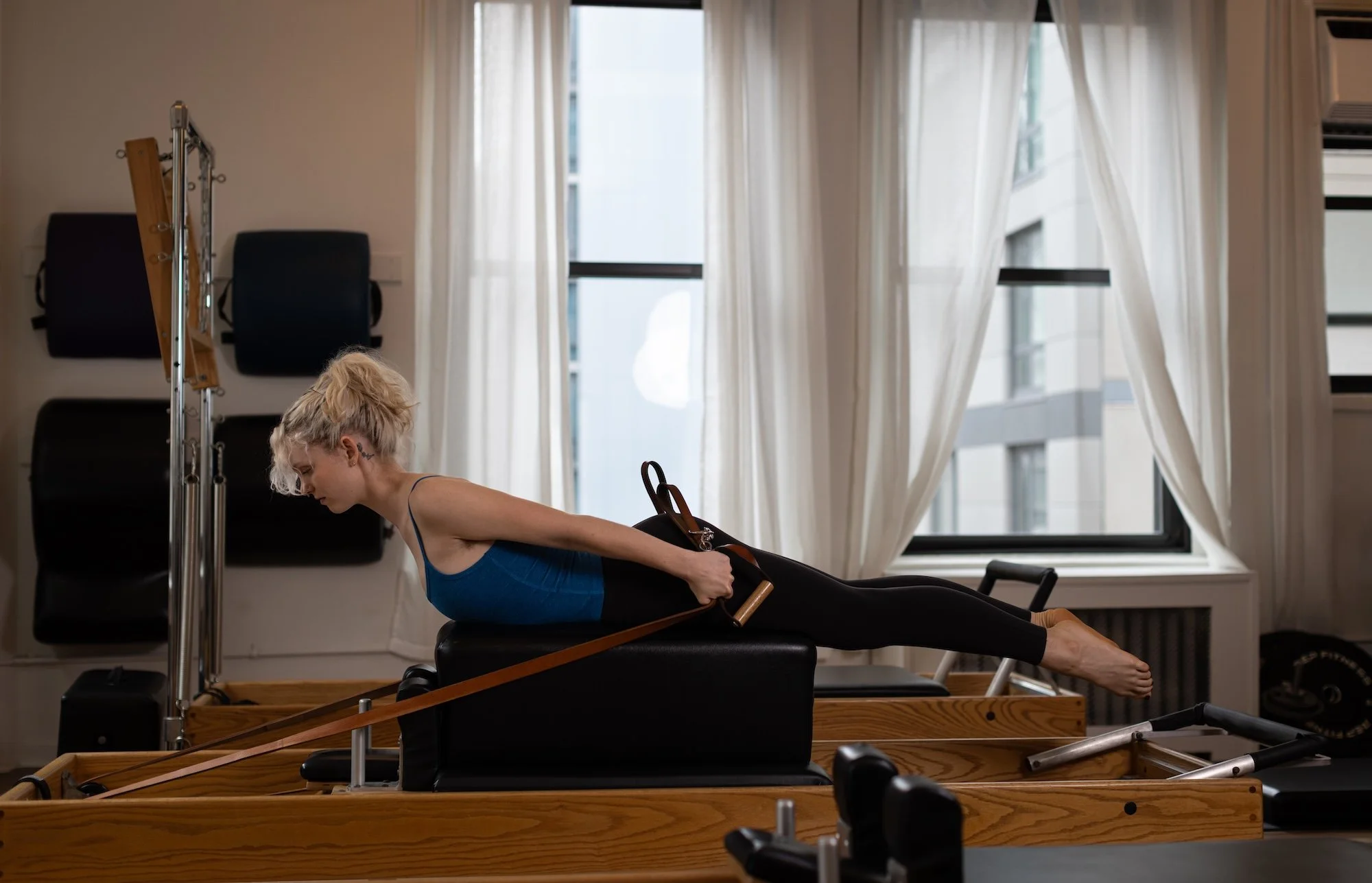
At The Pilates Room NYC, we believe Pilates fundamentally helps people build a deeper connection to their body. For individuals with hypermobility, this approach can be especially important. While some bodies naturally move beyond the typical range of motion in their joints, greater flexibility doesn't always translate to greater stability. In fact, hypermobile individuals may experience joint discomfort, fatigue, muscle tension or a feeling of being less grounded in their movement.
With an emphasis on controlled movement, muscular support, body awareness and proper alignment, Pilates can help people with hypermobility develop strength without relying on their joints to do more than they should.
What is hypermobility and how does it affect movement?
Hypermobility describes a greater-than-average range of motion in one or more joints. For some people, it's a natural characteristic. For others, it may be associated with joint pain, recurrent sprains, fatigue, hypermobility spectrum disorder (HSD) or hypermobile Ehlers-Danlos syndrome (hEDS). When joints move beyond their usual range, the surrounding muscles and connective tissues may have to work harder to provide stability. Some people may also find themselves resting into their joints rather than actively supporting their movement with their muscles.
This can show up in familiar ways: knees that lock backward while standing, elbows that extend beyond a straight line, shoulders that feel unstable during weight-bearing exercises or a tendency to sink into the lower back during movement. If you’ve ever heard someone described as double-jointed, this is likely a reference to someone who displays characteristics of hypermobility. In Pilates, we can address these patterns by focusing on how we move, not simply how far we can move. Rather than pursuing a deeper stretch or a bigger range of motion, a hypermobility-informed practice emphasizes control and strength within a comfortable range. It's an invitation to work with your body's needs instead of pushing against its natural limits.
Why Pilates Can Be Beneficial for Hypermobility
Here are a few ways Pilates can be particularly useful for people who need to build stability and body awareness.
1. Building strength around the joints
Strengthening the muscles that support the hips, shoulders, knees and spine can help improve functional stability. Exercises are selected and progress gradually, allowing the body to develop the strength for everyday activities such as walking, climbing stairs and maintaining comfortable posture.
2. Developing proprioception
Proprioception is the body's ability to sense where it is in space. Some hypermobile individuals find it challenging to recognize when a joint has moved beyond a useful range. Pilates encourages attention to alignment, muscular engagement and the quality of each movement, helping develop a clearer sense of positioning and control.
3. Improving movement efficiency
When joints are naturally mobile, it's easy to rely on passive flexibility rather than active muscular support. Pilates teaches the body to initiate movement with intention, distribute effort across muscle groups and avoid unnecessary strain.
4. Creating a more sustainable relationship with exercise
A well-tailored Pilates practice can help build confidence in movement without making every session a test of endurance or flexibility. Learning when to modify, rest or reduce the range of motion is just as important as learning how to perform an exercise.
It’s important to recognize that hypermobility can manifest differently from one person to another. The most appropriate exercises will depend on an individual’s symptoms, strength, experience and individual needs.
Safe Pilates Exercises for Hypermobility
A safe and effective Pilates practice begins with the right exercises, thoughtful modifications, and a willingness to progress carefully. The following movements can be useful starting points for some hypermobile individuals, provided they are comfortable and appropriate for their needs. They are examples, not a substitute for an individualized exercise plan.*
1. Pelvic Tilts and Breathwork
Focus: Core awareness and pelvic control
Begin lying on your back with your knees bent and feet resting comfortably on the mat. Inhale gently, allowing your rib cage to expand. As you exhale, engage your abdominal muscles and make a small, controlled pelvic movement, then return to a comfortable starting position. Keep the movement subtle rather than forcing your lower back flat against the mat. The goal is to coordinate your breath with your deep abdominal muscles while maintaining a relaxed neck and shoulders.
This exercise introduces the relationship between breath, core engagement and spinal movement without requiring a large range of motion.
2. Heel Slides
Focus: Core stability and controlled leg movement
Lie on your back with both knees bent. Gently engage your abdominal muscles while slowly sliding one heel away from your body. Return the heel to the starting position, then repeat on the other side.
The pelvis should remain relatively steady as the leg moves. Begin with a small range and shorten the movement if you notice your lower back arching or your pelvis shifting.
Heel slides offer a way to challenge core control without immediately progressing to more demanding exercises such as full leg extensions or double-leg lowers.
3. Glute Bridges
Focus: Hip strength and posterior-chain support
Start on your back with your knees bent and feet hip-width apart. Exhale as you gently engage your glutes and lift your pelvis a comfortable distance from the mat. Pause briefly, then lower slowly.
Think of creating length through the front of the hips rather than lifting as high as possible. Avoid pushing your ribs upward, overarching your lower back, or locking your knees.
If a full bridge feels uncomfortable, begin with a small pelvic lift or practice gentle glute contractions without lifting. These variations can help develop strength while keeping the exercise manageable.
4. Side-Lying Leg Lifts
Focus: Hip stability and lateral strength
Lie on your side with your head supported and your hips comfortably stacked. Keep your top leg in line with your body and lift it a small distance, then lower with control.
Avoid rolling your pelvis backward or lifting your leg so high that you lose alignment. A smaller, precise movement is often more useful than a large movement that relies on momentum.
Strengthening the muscles around the hips may support pelvic control during everyday movements.
5. Supported Arm Work
Focus: Shoulder stability and postural awareness
Shoulders can be particularly challenging for some people with hypermobility. Begin seated or lying down, using light resistance or no resistance at all. Practice gentle arm movements while keeping the shoulders relaxed and the shoulder blades comfortably supported against the rib cage.
A Pilates instructor may introduce light resistance bands or small hand weights as appropriate. Avoid hanging into the shoulder joints, forcing the arms overhead, or pushing through positions that feel unstable. If weight-bearing through the wrists or shoulders is uncomfortable, a supported position may be a more appropriate starting point.
Essential Techniques for a Hypermobility-Informed Practice
Choosing appropriate exercises is only part of the equation. The way they are performed matters just as much. Work within a controlled range of motion. Greater flexibility doesn't mean you need to use your full range. Practice moving where you can maintain muscular control, rather than reaching the furthest possible position.
Avoid habitual joint locking. Notice whether your knees, elbows, or other joints tend to push backward when you stand or exercise. Where appropriate, maintain a comfortable, neutral position rather than resting at the end of your range. Your instructor will individualize this cue rather than rigidly restricting every movement.
Prioritize quality over quantity. A few controlled repetitions can be more productive than a long sequence performed with fatigue or compensation. Start with a manageable workload and increase repetitions, resistance or duration gradually, one variable at a time.
Use props and modifications. Cushions, blocks, resistance bands, and the support of a Reformer or other Pilates apparatus can help make movement more accessible. Props should improve comfort and control, not push you into a deeper stretch.
Breathe continuously. Holding your breath can increase unnecessary tension and make movement harder to regulate. Maintain a natural breathing rhythm, particularly during strengthening exercises.
Pay attention after class. Your response to exercise matters beyond the studio. If a session causes increased pain, joint instability, unusual fatigue or a prolonged symptom flare, reduce the intensity and discuss the response with your instructor or healthcare provider. Progress should feel sustainable rather than punishing.
These principles align with guidance from the Ehlers-Danlos Society, which emphasizes individualized exercise, controlled movement, and gradual progression for people with hypermobility-related conditions.
What Should You Avoid or Modify?
For many hypermobile individuals, aggressive stretching and repeated movement into extreme ranges may be less helpful than targeted strengthening. Be cautious with exercises that encourage you to hang passively into your joints, push through instability or continue when technique deteriorates.
High-impact movements, rapid transitions, and heavily loaded exercises may also need modification, particularly when joint instability or pain is present. This does not mean these activities are universally off-limits; the appropriate choices depend on your individual condition and level of control.
It's also important to remember that not every sensation of tightness means a muscle needs stretching. Sometimes, overworked muscles feel tight because they're trying to compensate for inadequate stability elsewhere. Building strength and improving movement coordination may be more appropriate than stretching further.
Finding Your Strength
We believe your body doesn't need to be pushed to its limits to become stronger. For people with hypermobility, Pilates can offer an opportunity to develop control, build muscular support, and approach movement with greater awareness. The most effective practice isn't necessarily the most advanced or physically demanding. It's the one that helps you progress with intention. Some days, that may mean adding resistance or exploring a new exercise. Other days, it may mean choosing a smaller range or focusing on breath and alignment. Both can be meaningful parts of a sustainable practice.
With individualized instruction, appropriate modifications, and a gradual approach to strengthening, Pilates can become a valuable part of your movement routine.
*As with anyone returning to exercise from injury or addressing a specific physical condition like hypermobility, we recommend getting clearance and more information from your physician before attempting any specific exercises without guidance.
Pilates invites you to notice what’s happening beneath the surface. The more you understand these underlying principles, the more your practice becomes something you can rely on.
At The Pilates Room NYC, we believe that Pilates is for every body, and that learning how to work with your body is where the real work begins. Come join us for a session and find out what you’re capable of.