
Pilates for Runners: How Pilates Helps You Run Stronger, Longer and With Fewer Injuries
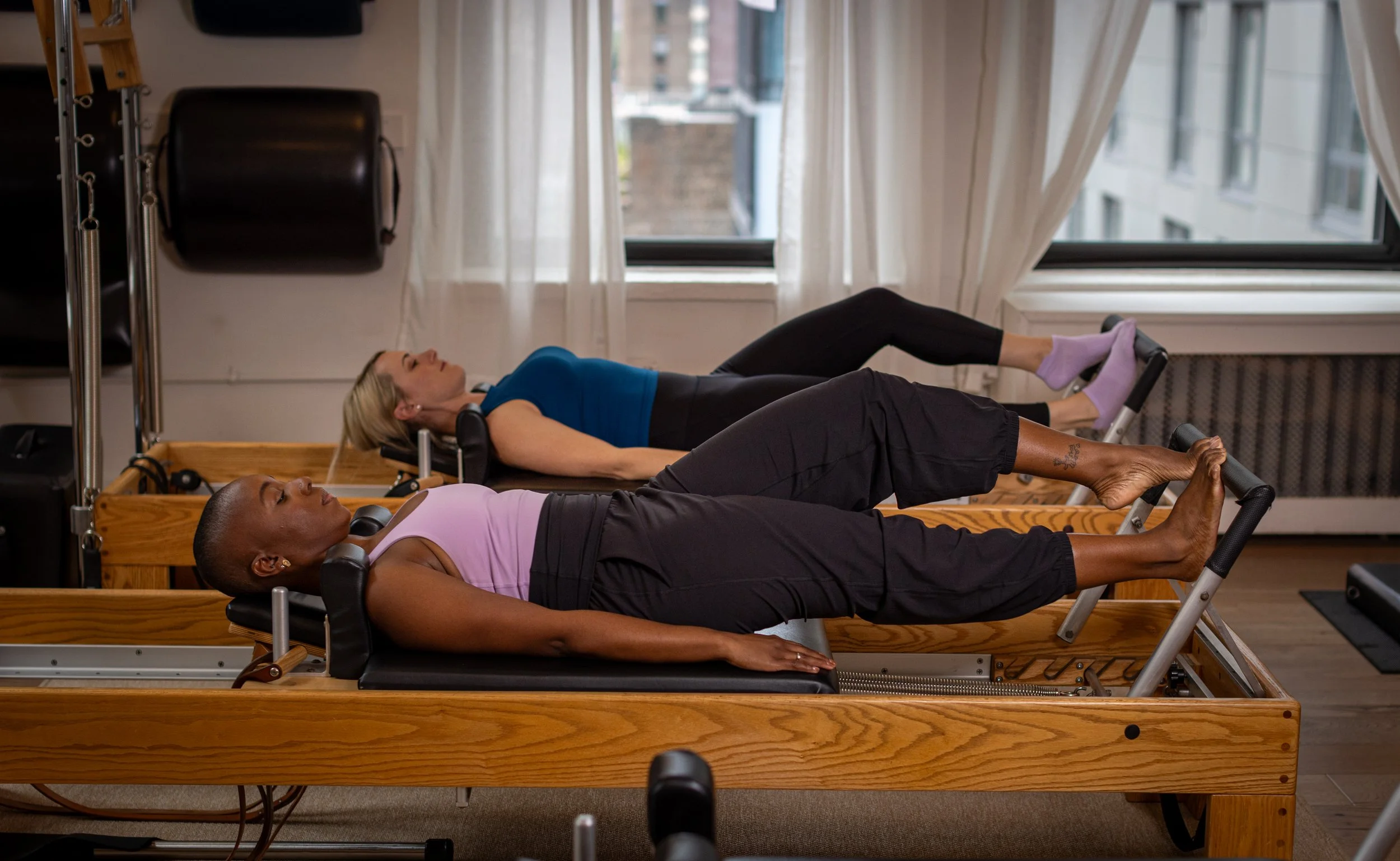
Every November tens of thousands of runners cross the five boroughs on their way to the finish line of the New York Marathon. October brings the final weeks of training for these athletes, and after months of accruing mileage, unfortunately it’s a time when stress fractures and other overuse injuries begin to surface. Many of our clients come to us to help rehab injuries sustained from long-distance running. But we have a radical take: what if runners came to us before they were injured to help strengthen their bodies to prevent injuries in the first place? When practiced consistently, classical Pilates can help runners become more efficient, stronger and more balanced.
Why running needs a counterbalance
Running is deceptively simple: one leg in front of the other for what may be hours on the road. The simplicity running offers can result in one of its biggest drawbacks. Running occurs almost entirely in one plane of motion—forward—and repeats the same pattern over and over. With time, some muscles get very strong and very tight, while others are barely recruited at all. Because of this, many runners that we see share a familiar profile: tight hip flexors and hamstrings, a lower back that works overtime, and hips that drop or collapse with each stride because the muscles on the outside of the hip aren't pulling their weight. Add in eight hours at a desk every day, and you have a perfect slow-cooker recipe for injury.
Pilates is a great supplemental exercise for runners, since it addresses these types of muscle stressors and imbalances. Repetitive training can strengthen some muscles while leaving others underdeveloped. Our job is to restore a balanced musculature, which supports healthier movement patterns and better stability. For a runner, that translates directly to more pain-free miles.
How Pilates supports runners
Every Pilates exercise starts from the core: the muscles of the abdomen, back and hips that support the spine and stabilize the pelvis. When you run, each foot strike sends force up through your body. A strong, responsive center keeps your pelvis level and your torso steady, so energy goes into moving you forward instead of leaking out through wobbling hips or a swaying upper body. Here are some other specific ways Pilates helps support runners:
Hip strength in every direction.
Running asks your hips to move forward and back. Pilates asks them to move in every direction: sideways, in rotation, in circles. That variety builds strength in the stabilizing muscles that keep your knees tracking well and your stride clean.
Mobility without losing control
Runners are often told to stretch more. Pilates takes a different approach, building flexibility and strength at the same time so that your new range of motion serves your running patterns and helps prevent injury.
Better breathing
Breath is central to the Pilates method. Learning to breathe fully and with control, especially into the back and sides of the ribcage, translates directly to a running practice. Runners must regulate their breathing to stay relaxed and efficient. When they start to tire, they may start breathing clipped, shallow breaths. Learning to breathe more fully can help runners stay loose for the long haul.
Body awareness
Pilates teaches you to notice how you move: where you hold tension, which side works harder, when your form starts to slip. Runners who build that awareness tend to catch small problems before they become full-blown injuries.
Low-impact training
Pilates builds strength without adding stress to your joints, which makes it an ideal complement on recovery days, during a training block or while returning from injury.
Classical Pilates exercises runners love
Every runner's body is different, which is why we tailor our sessions to our clients’ needs. But a few classical exercises come up again and again in our work with runners.
Footwork on the Reformer
The classic opening to a Reformer session is a runner's best friend. The tension from pressing the carriage out and in against the springs trains the legs in alignment, from hip to knee to ankle, while the feet work through different positions. One variation is even called running: alternating heel lowers that strengthen the calves and feet and mobilize the ankles.
The Hundred
This foundational mat exercise builds abdominal endurance and teaches you to coordinate breath with effort. Holding steady while your breath moves is a skill you'll use late in a long run.
Single Leg Circles
Lying on your back, you circle one leg while keeping the pelvis still. It's a simple-looking exercise that shows runners exactly how much (or how little) control they have around the hip joint, while gently mobilizing it.
Single Leg Stretch
Alternating legs in and out while the torso stays lifted and stable echoes the reciprocal pattern of running, and challenges the core to keep the pelvis quiet as the legs move.
The Side Kick Series
Lying on your side, you move the top leg forward, back, up and in circles while the rest of the body stays still. These exercises target the outer hip muscles that so many runners neglect, the same muscles that help keep your pelvis level with every stride.
Shoulder Bridge
Lifting the hips and extending one leg strengthens the glutes and hamstrings while the pelvis stays level on a single supporting leg. That single-leg stability is exactly what running demands.
Swan
Runners spend a lot of time leaning forward. Swan works the back extensors and opens the front of the body, an important counterbalance to tight hip flexors and rounded shoulders.
Spine Twist and Saw
Running is mostly forward motion, but a healthy spine needs to rotate. These exercises restore that rotation and help free up the upper back, which supports a more natural arm swing.
Going Up Front on the Wunda Chair
Stepping up onto the chair against spring resistance builds single-leg strength and balance, and quickly reveals any difference between your right side and your left.
Running Supports Pilates, too!
Make no mistake…the relationship goes both ways. Runners often arrive in our classes with strengths that serve them well in the studio. Running builds cardiovascular endurance, which helps when a classical session starts to pick up pace. Runners are used to consistency, showing up day after day and trusting gradual progress, and that's exactly the mindset Pilates rewards. And the impact of running loads the bones and legs in a way Pilates doesn't, so the two practices fill in each other's gaps.
Many runners also have a well-developed sense of rhythm and pacing. Classical Pilates has a flow to it, with one exercise leading into the next, and runners often take to that rhythm quickly. The most rewarding part is watching the two practices start to inform each other. A client notices her hips feel steadier on a hill. Another realizes he's been gripping his shoulders for years, and lets go. The awareness built on the Reformer shows up on the road, and the road gives us feedback to bring back into the studio.
How to fit Pilates into your training
Many runners find that one or two Pilates sessions a week makes a noticeable difference in their training. Pilates can be included on easy days, and it can be adjusted in conjunction with your training calendar, with more strength work during base building and lighter, more restorative sessions as race day approaches.
If you're coming back from an injury, Pilates can be an important part of your return. Our instructors have worked with clients recovering from a wide range of injuries, and we're happy to work with you to help address your specific needs. Most importantly, we'll meet you where you are. Whether you're training for your first 5K or your tenth marathon, we'll create a program that helps support your running goals and keep you injury-free.
Pilates invites you to notice what’s happening beneath the surface. The more you understand these underlying principles, the more your practice becomes something you can rely on.
At The Pilates Room NYC, we believe that Pilates is for every body, and that learning how to work with your body is where the real work begins. Come join us for a session and find out what you’re capable of.