
Pilates Footwork: How Strong Feet Impact Your Whole Body
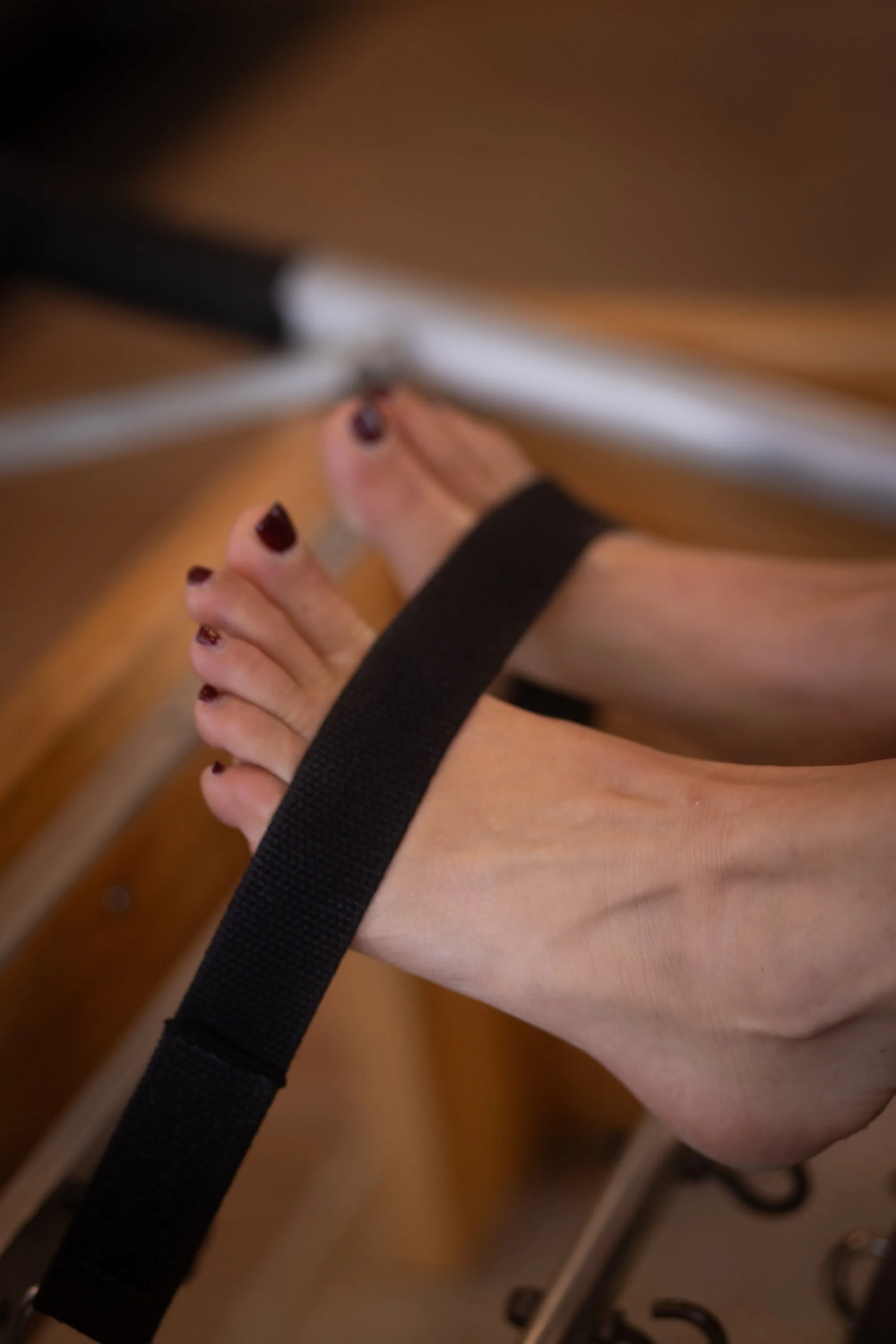
There's a reason Joseph Pilates began nearly every session on the Reformer with footwork. Beyond being simply a point of contact with the footbar, the feet provide a source of information, a measure of alignment and the very beginning of the kinetic chain that runs all the way through your spine. When your feet work well, everything above them has a better chance of working well too.
This might come as a surprise to people who think of Pilates as a core workout. The core does matter, but the foundation beneath it matters just as much. A well-designed structure can't compensate for a shaky base. The same is true for the body: the most engaged abdominals and the most carefully lifted spine won't fully protect you if the feet they're resting on are collapsed, rigid or disorganized. Strong, mobile feet might be the most underappreciated aspects of a well-rounded Pilates practice.
What "Footwork" Actually Means
In classical Pilates, footwork is a series of exercises performed on the Reformer at the very start of a session. You lie on your back, press your feet into the footbar, and move through variations in foot position: parallel, Pilates V (heels together, toes apart), wide stance, and more, while pressing the carriage out and drawing it back with control. It looks simple. It is not.
Done with intention, footwork teaches your legs to extend evenly from a stable pelvis, your heels to stay connected and your arches to lift, your ankles to move without rolling, and your breath to coordinate with effort. It's essentially a full-body calibration dressed up as a leg exercise. Your instructor watches not just your legs but your hips, your lower back, the way your ribs behave, even how you hold your jaw. Everything shows up in footwork.
The Foot as a Sensory Organ
Your feet contain roughly a quarter of all the bones in your body: 26 bones, 33 joints and more than 100 muscles, tendons and ligaments, all packed into a structure roughly the size of a paperback book. More relevant to movement is what happens neurologically: the soles of your feet are densely packed with sensory receptors that communicate constantly with your brain about position and ground contact. When those receptors are working well, your balance improves and your nervous system has better information to work with when it decides how to stabilize you.
Modern life tends to mute that communication. Shoes with thick cushioned soles, long hours of sitting, hard flat surfaces and habitual patterns of weight-bearing all contribute to feet that have essentially gone quiet. Pilates footwork wakes them back up. By pressing intentionally through different parts of the foot—the ball, the arch, the heel, the individual toes—and by maintaining that awareness through each repetition, you start to restore the feedback loop between your feet and the rest of your body.
How Feet Affect Everything Above Them
Consider what happens when the arch of the foot collapses inward, a pattern called overpronation. The ankle rolls in slightly. The knee tracks inward in response. The hip rotates internally. The pelvis may tilt. The lumbar spine compensates. By the time you trace the chain upward, a foot that isn't supporting itself properly has created ripple effects through the knee, hip, pelvis, and back—often without any sensation in the foot itself. The discomfort shows up somewhere else entirely, and the source goes unaddressed.
This is why we often pay close attention to your feet even when you come in for back pain, hip tightness or knee issues. In a client-centered practice like ours, we look at the whole picture. Footwork isn't a warm-up to get through on the way to the "real" exercises. It's diagnostic and it's where many of the most meaningful changes in the body begin.
Building a Stable Foundation: What to Pay Attention To
The most important concept in Pilates footwork is the tripod of the foot: the three points of contact that create a stable base—the ball of the foot beneath the big toe, the ball of the foot beneath the little toe, and the center of the heel. When all three are grounded and the arch lifts between them, the foot functions as an intelligent structure rather than a passive platform.
In practice, this means a few things. First, resist the urge to grip with your toes. Tension in the toes usually means tension throughout the leg, which prevents the kind of fluid movement that Pilates requires. Instead, let the toes spread and reach long while the three points of the tripod stay connected. Second, pay attention to whether you're pressing evenly through both feet. Most people have a dominant side, and footwork can reveal asymmetries that show up as back pain, hip imbalances or an uneven gait. Third, notice whether your heels are pushing or pulling differently than your toes. In Pilates V position especially, the tendency is to turn out from the knees rather than the hip joints — a common compensation that footwork, done correctly, will help you identify and retrain.
Why This Translates Beyond the Studio
The benefits of attentive footwork aren't contained to your sessions. When your feet learn to move with more intelligence and less compensation, that pattern starts to carry into the way you walk, stand, climb stairs and navigate the city. New Yorkers spend more time on their feet than those who live in suburban and rural areas. And we walk on hard pavement, in varied footwear, often at a relentless, non-tourist pace. A body that has learned to move from a stable, responsive foundation handles all of that more efficiently—with less wear on the joints and better posture.
There's also something more subtle at work. When you slow down enough to feel what your feet are doing, you develop a quality of body awareness. Clients often describe this as feeling more grounded, more at home in their bodies, more present. That's not a coincidence. The feet are, in a very literal sense, where we make contact with the earth. Teaching them to do that well has consequences that reach all the way up through the body.
If you've been coming to Pilates and skimming past footwork mentally while waiting for the ab work to begin, we gently encourage you to reconsider. Next session, arrive curious about your feet. See what your instructor sees. You might be surprised how much is already there to work with.
Pilates invites you to notice what’s happening beneath the surface. The more you understand these underlying principles, the more your practice becomes something you can rely on.
At The Pilates Room NYC, we believe that Pilates is for every body, and that learning how to work with your body is where the real work begins. Come join us for a session and find out what you’re capable of.