The Polarizing, Inimitable Wunda Chair
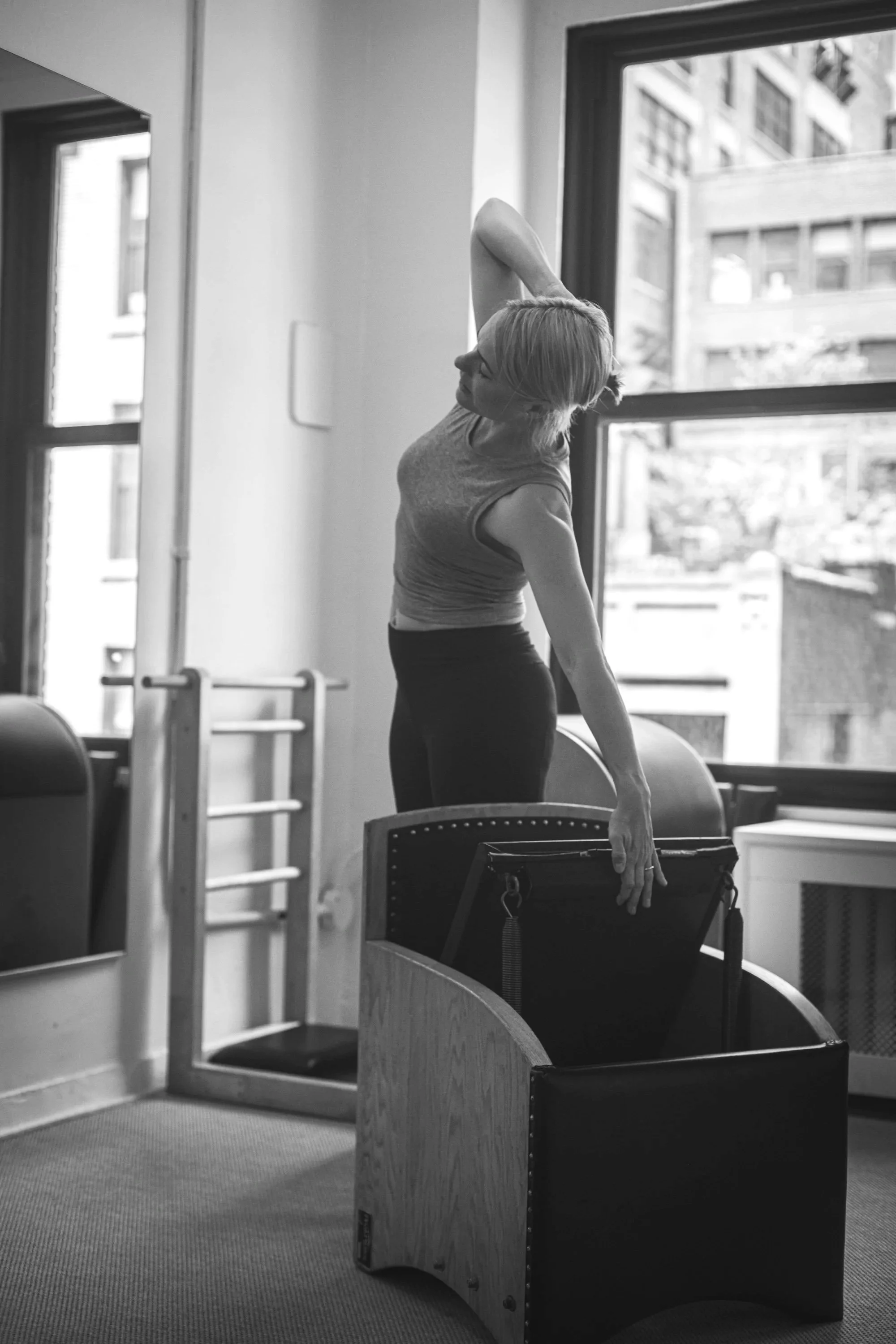
Walk into The Pilates Room NYC and your eyes will likely land on the reformers first. Long, elegant and unmistakable, they tend to command a room. But look to the left, and you’ll see a compact piece of equipment that looks almost like a step stool. That is the Wunda Chair, and it is one of the most powerful, challenging and brilliantly conceived pieces of apparatus in the entire Pilates method.
Joseph Pilates invented the Wunda Chair in the 1940s, and the story behind it captures something essential about who he was. He wanted his clients to be able to take their practice home with them—to turn a piece of exercise equipment into a piece of furniture. The Wunda Chair could double as a stool in a New York City apartment, and when the cushion was lifted and the pedal engaged, it became a full-body conditioning tool. That dual purpose was a reflection of Pilates' core belief: that movement should be woven into everyday life, not separated from it.
The chair itself is deceptively simple. It consists of a small padded seat mounted on a box-like base, with one or two spring-loaded pedals at the bottom. The springs provide resistance that can be adjusted by the instructor, making it appropriate for a wide range of clients and goals. And yet despite how modest it appears, the Wunda Chair has a well-earned reputation for being humbling, even among seasoned practitioners.
Why the Chair Is So Challenging?
What makes the Wunda Chair uniquely demanding is that it asks the body to work in an upright, functional position with very little surface area for support. On the reformer, you have a carriage beneath you. The Chair gives you a narrow pedal and your own sense of balance—and that combination requires a level of full-body integration that is hard to replicate on any other piece of equipment.
In many exercises, the practitioner sits, stands or kneels on top of the seat and presses or lifts the pedal with the hands or feet. The coordination required to do this while maintaining alignment, breathing fully and engaging the powerhouse is considerable. There is nowhere to hide. Imbalances that may have gone unnoticed on the reformer become immediately apparent on the Chair. Working one side of the body may feel entirely different from the other. The core may grip in places it shouldn't. The breath may shorten under pressure.
This is exactly what Joseph Pilates intended. The Chair teaches the body to organize itself under load, to find stability from the inside out rather than relying on external support. Over time, this translates directly into how a person stands, walks, lifts and moves through their daily life.
The Exercises and What They Develop
The Wunda Chair repertoire is rich. Some of the most foundational exercises include footwork, in which the client sits on top of the Chair and presses the pedal down with the feet while maintaining a long, neutral spine—similar in intent to the footwork series on the reformer, but it requires far more postural control since there is no carriage to lie back against.
Going Up Front and Going Up Side are standing exercises in which the client places one foot on the pedal and presses it down while the other foot remains on the floor, essentially performing a single-leg press while keeping the trunk completely stable. These movements are useful for developing hip and glute strength, ankle stability and the kind of controlled lateral body awareness that helps prevent injury.
Pumping, where the seated client drives the pedal down and up with a pressing motion, trains rhythmic breath coordination, lower-body activation and the ability to move the pedal through the legs while the upper body remains stable. It strengthens the glutes, quadriceps, hamstrings, calves and ankles while engaging the upper body's stabilizing muscles. The challenge of keeping the spine lifted and quiet while the legs move below requires strength and extraordinary precision.
For the upper body, exercises like the Swan and Tendon Stretch on the Chair are transformative. The Swan develops thoracic extension, while the Tendon Stretch develops thoracic flexion. Together, they also build shoulder stability and strengthen the deep back muscles that support upright posture—areas that many people in modern life desperately need to strengthen. These exercises can look extraordinary when performed with full range of motion, but they begin with much smaller, more careful movement, and that progression is important.
Who Benefits from the Wunda Chair?
At TPR NYC, we incorporate the Chair across a wide range of clients and goals. For those recovering from lower extremity injuries or working on single-leg stability, the Chair offers targeted, supported strengthening that is hard to find elsewhere. For dancers and athletes, it builds the kind of explosive control that is essential for performance. For clients managing back pain, the Chair's emphasis on trunk control under load and balance can be transformative.
The Chair is also particularly effective for clients who have developed strong foundations on the mat and reformer and are ready for a deeper challenge. Many of our practitioners have their first real introduction to the Chair after six months or more of consistent work, and the encounter tends to be revelatory. The Chair has a way of asking honest questions of the body.
That said, the Chair is absolutely not reserved for advanced practitioners only. With skilled instruction, early-level exercises can be introduced safely and meaningfully. A good Pilates teacher knows how to meet a client where they are and sequence the Chair work in a way that builds confidence and strength.
A Piece of Equipment Worth Knowing
There is a reason the Wunda Chair has remained central to classical Pilates training for more than eighty years. It is not a trend or a novelty. It is a precision-engineered tool that reflects the depth of Joseph Pilates' understanding of human movement—his belief that the body is most intelligent when it works as a whole, that true strength is both functional and graceful, and that challenge, when offered with care, creates transformation.
Curious about the Wunda Chair, or any of the other apparatus we work with at The Pilates Room NYC? Get in touch and we'll find the right session for you. Get started here.